 The Surface You Have Determines the Protection It Needs
Monumental Workx applies countertop protection film San Diego homeowners, restaurant operators, and office managers rely on — and the first question is always the same: what surface are we protecting? Marble, granite, and quartz each have distinct vulnerabilities. A marble countertop fails in ways quartz never will. Quartz has weaknesses marble doesn’t. Getting the protection strategy right starts with understanding what each material is actually up against in a busy kitchen.
All three surfaces are valuable. All three can be damaged in ways that cost real money to fix. But the threats are material-specific, and so is the urgency of getting protection film applied before damage happens rather than after.
Marble Countertops: Beautiful, Expensive, and Surprisingly Vulnerable
Marble is the most demanding surface to protect — and the one where countertop protection film makes the strongest case. Marble is a natural stone formed from calcium carbonate, which means it reacts chemically to acids. Lemon juice, red wine, tomato sauce, vinegar, coffee, and many cleaning products cause etching — a physical change to the surface that appears as dull, matte patches. Etching is not a stain you can clean off. It’s structural damage to the stone face.
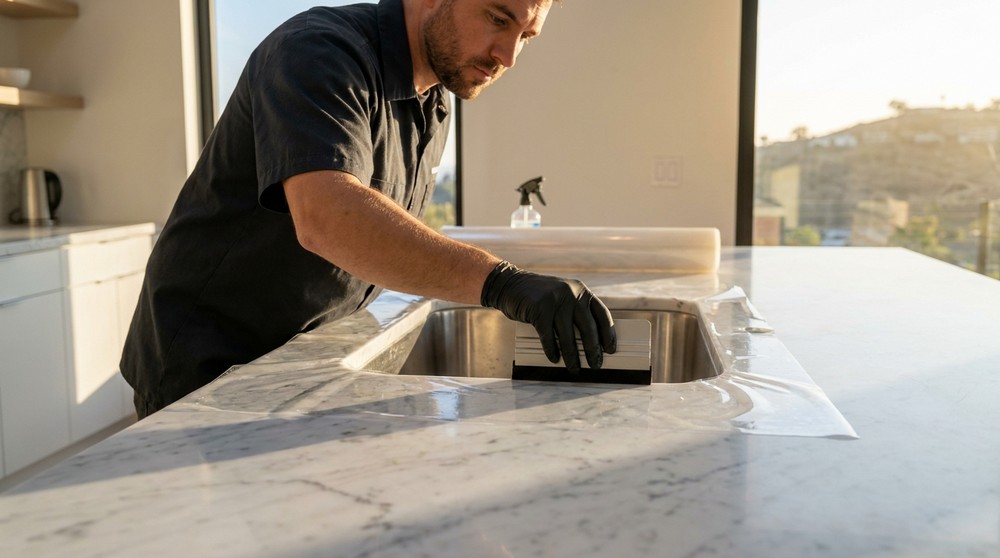
Marble countertop protection film solves this by putting an invisible barrier between the stone and your kitchen’s daily chemical environment. The film absorbs the contact instead of the stone. It’s optically clear, so the veining and color of your marble read through exactly as intended. And since the film is removable without damaging the surface beneath, you’re not altering the stone permanently — you’re just protecting it.
In San Diego neighborhoods like La Jolla and Del Mar — where marble kitchens are common in high-end homes — professional marble countertop protection film typically runs $200 to $600 for a standard kitchen surface area. Professional re-polishing after acid etching damage costs the same range or more, and it doesn’t return the stone to its original condition. Film prevents the problem; restoration manages it afterward.
Granite: The Most Durable Natural Stone Still Has Weak Spots
Granite earned its reputation as the toughest natural countertop material. It’s harder than marble, less chemically reactive, and more resistant to heat and scratching. That said, granite is still porous. Without an active sealant — or with one that’s worn down over years of use — granite absorbs oils, moisture, and staining liquids that can permanently alter the surface color and appearance from beneath.
Granite countertop protection creates a surface layer that keeps contaminants out regardless of the underlying sealant’s condition. For granite in high-use cooking zones, areas near the stovetop where oils and splatter are constant, or outdoor kitchen applications exposed to San Diego’s coastal salt air, film protection extends the surface’s clean appearance significantly. Granite is lower priority than marble, but it’s not zero priority — especially in commercial settings where surfaces see heavy daily use.
Quartz: Engineered to Be Tough, But Not Without Vulnerabilities
Quartz countertops are manufactured — ground stone particles bound with polymer resins — specifically engineered to outperform natural stone on durability metrics. They’re non-porous, highly scratch-resistant, and don’t require periodic sealing. Most homeowners assume quartz takes care of itself. It largely does, with a few real-world exceptions that matter.
The polymer resin binders in quartz can discolor with sustained UV exposure. In San Diego, where sunlight angles through kitchen windows most of the year, quartz surfaces in direct afternoon sun can develop gradual yellowing or bleaching over years of exposure. Sharp edge impacts can also chip quartz, and aggressive commercial cleaning products degrade the finish over time.
Quartz countertop protection film blocks UV at the surface before it reaches the resin. For homeowners running a busy kitchen, rental property operators, or commercial spaces using strong cleaning chemicals, film adds meaningful longevity at a fraction of the surface’s replacement cost.
Not sure which protection option fits your surface? Get a Free Estimate from Monumental Workx — we assess your material, condition, and installation environment and recommend the right approach.
Stone Guard Film vs. Standard Sealants: They’re Not the Same Thing
Homeowners who’ve sealed their countertops before sometimes wonder whether Stone Guard film adds anything meaningful. It does — because sealants and protection film work completely differently. A sealant penetrates the stone and fills pores to slow liquid absorption from below. It doesn’t create a surface barrier against physical scratching, acid etching, or UV exposure. The protection is subsurface and chemical.
Stone Guard film sits on top of the surface and intercepts damage before it reaches the stone at all. It’s a physical shield rather than a chemical one. For marble, where etching happens at the surface on contact, a sealant alone doesn’t stop the damage — the acid reacts with the stone face, not through it. Film stops the contact from happening. For granite and quartz, both approaches work well together, with film handling the physical and UV threats that sealants don’t address.
Commercial Kitchens and Restaurant Surfaces: Where Film Pays the Most
The ROI calculation on countertop protection film San Diego restaurants and commercial operators face is direct. Commercial prep surfaces take daily punishment from knives, industrial cleaning chemicals, constant high-volume use, and food contact that never fully stops. A visible scratch or stain on a surface facing a health inspector is a problem. A countertop replacement in a working kitchen means operational downtime that compounds the material cost significantly.
Restaurants that use Monumental Workx for countertop protection services typically run the film as scheduled maintenance — replacing it on a 1–2 year cycle rather than dealing with surface repairs reactively. Stone Guard handles commercial-grade cleaning protocols without breaking down, which is a baseline requirement for food service environments. The spend is predictable. Surface damage is not.
Frequently Asked Questions
What’s the difference between Stone Guard countertop film and a standard stone sealant?
A sealant penetrates the stone and fills pores to slow absorption — it doesn’t create a surface barrier against physical scratching, etching, or UV exposure. Stone Guard film sits on top of the surface and intercepts damage before it reaches the stone. They address different threat types and, ideally, work together. Film is a physical shield; sealant is a chemical one.
Can protection film be applied to a countertop that already has some scratches or light staining?
Light wear and minor surface marks are fine — the film covers them and stops further damage from accumulating. Deep staining, significant etching on marble, or surface cracks should be addressed before installation. Monumental Workx assesses surface condition during the free estimate and will tell you directly whether pre-treatment is needed for the film to bond correctly.
How do I clean countertops that have protection film installed?
Standard cleaning works fine — warm water, mild dish soap, and a soft microfiber cloth. Avoid abrasive scrubbers and cleaners containing acetone or bleach. Day-to-day cleaning is actually easier once the film is on, because liquids bead and wipe off instead of sitting on a porous surface. Restaurants using commercial disinfectants should discuss chemical compatibility with Monumental Workx before installation.
Which countertop materials are not good candidates for protection film?
Heavily textured surfaces with deep grooves can make consistent film adhesion difficult. Laminate in poor condition may not bond correctly. Surfaces with active moisture problems from beneath — common in older kitchens with aging substrate materials — need remediation before film application. A site assessment during the estimate conversation identifies these situations before the job starts.
How Monumental Workx Installs Countertop Protection Film in San Diego
The process starts with a surface assessment — material type, current condition, edge configuration, and how the space is used. That information drives the product choice and installation approach. Stone Guard film is cut to fit precisely, applied without air pockets, and trimmed cleanly at every edge and cutout. Installation on a standard kitchen typically takes a few hours.
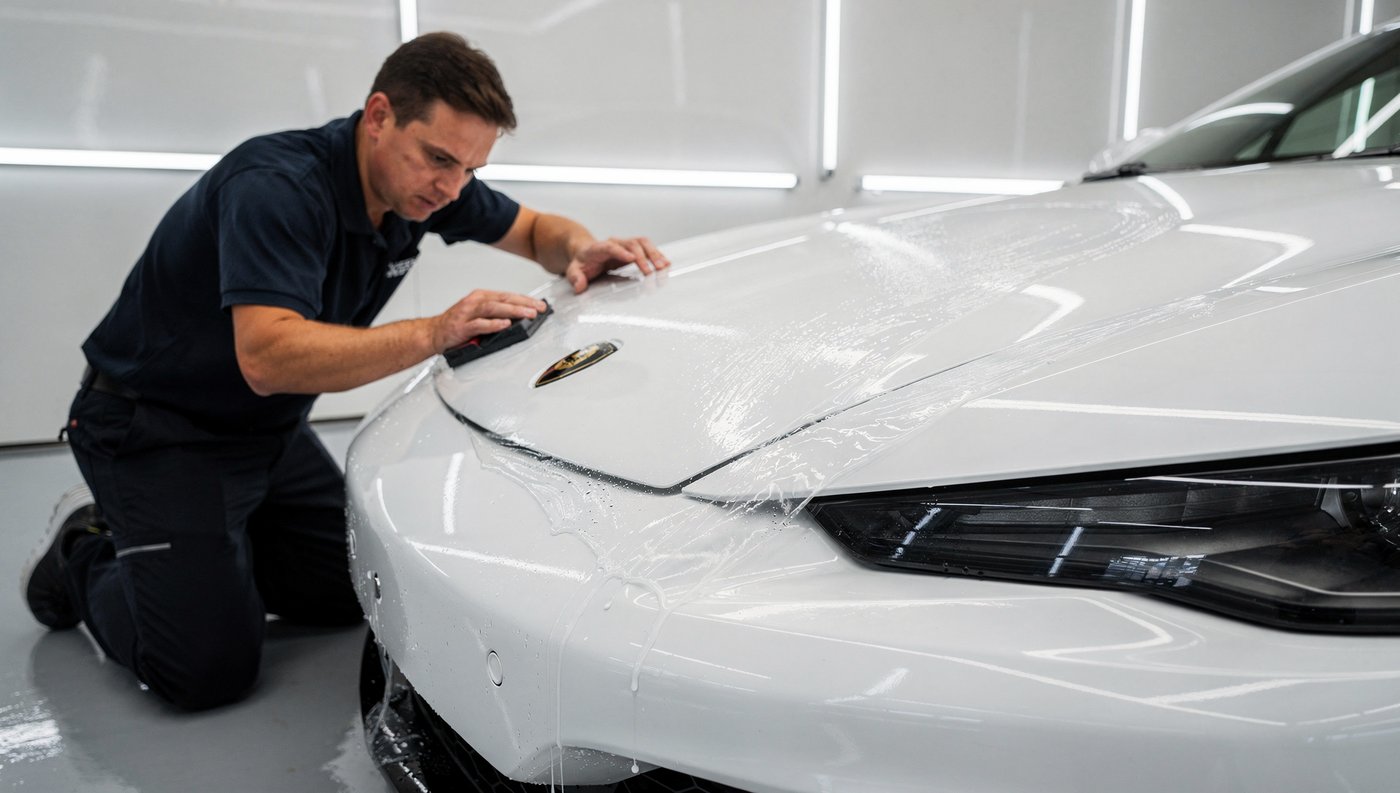
Monumental Workx has been applying precision film work since 2004, starting with automotive paint protection film and extending that same expertise to indoor surface protection. The same attention to film adhesion, edge finishing, and optical clarity that goes into a vehicle PPF install goes into every countertop job. If you’re considering kitchen surface protection for your home, restaurant, or commercial space in San Diego, learn how the service works and request a free estimate to get started.
Ready to Get Started?
Whether it’s marble in La Jolla or quartz in a Carmel Valley kitchen, Monumental Workx has the experience to protect it right — with professional-grade Stone Guard film and over 20 years of precision installation behind every job.
Get a Free Estimate or call us at (858) 291-8200.